Tuesday, February 15, 2022

2.15.22 Meeting Summary

Tonight the council discussed two significant items:

- The first was receiving the FY21 audited financial statements.  Normally this is a perfunctory process where we get a read out of the results and accept them.  The audit is completed already and there isn't going to be anything that happens that changes that.  Tonight however, was a bit different.  

For a number of reasons, including staff turnover and generally poor financial practices, the City got some disappointing news.  In every audit, there are required communications from the independent auditor to the governing body, in this case the City Council. We were informed that during the course of the audit, there were four material weaknesses identified, and one significant deficiency in internal controls. 

These are industry terms - a material weakness is a a deficiency, or a combination of deficiencies, in internal control over financial reporting, such that there is a reasonable possibility that a material misstatement of the company's annual or interim financial statements will not be prevented or detected on a timely basis. A significant deficiency is a deficiency, or a combination of deficiencies, in internal control over financial reporting that is less severe than a material weakness, yet important enough to merit attention by those responsible for oversight of the company's financial reporting.

As an accountant, I'm very familiar with these terms.  Even a single material weakness could have severe consequences in a private corporation.  Four together is an indication of severe problems in an organization.

We discussed how subledgers in the City's accounting system don't reconcile to the main GL.  We discussed the fact that the ledger is not closed on a monthly basis, or that books are open for several months at a time.  We discussed that one of the key controls in any organization - reconciling bank accounts, was not being performed.  We discussed an instance of fraud where nearly $40K was stolen (mostly recovered through insurance) due to poor controls over financial systems.  And with the City receiving federal funding for ARPA, there will be even greater requirements over internal controls next year.

What we heard painted a bleak picture of the control environment at the City.  Rather than relitigate what happened, I felt it would be more productive to focus on how we can right the ship.  I requested a plan of action that identifies all the challenge areas, develops a game plan and timeline for remediation, a list of resources necessary to achieve those outcomes, and an identification of the biggest potential impediments to being successful.  I asked that more frequent updates are made so we can compare actual results to this established plan.  It's a tall order, and it will take dedicated effort over time to achieve these outcomes.

- Next we discussed whether to appropriate $30K to engage a consulting firm to perform research related to a potential tax measure for the November 2022 ballot.  The idea was to conduct polling to determine the amount and type of tax that people would generally support.  Because the required vote is actually 2/3 (we found that out tonight), there is this sentiment that the city should advance a tax measure that would fall within some acceptable range so people would support it.

I felt this approach was backwards.  Rather than trying to determine the most people would support, I suggested we determine what the minimum amount is that is necessary to fund critical government functions.  Ultimately the city is projected to be in deficit spending starting with FY23.  We can determine what is necessary to avoid that, and then place on the ballot that amount.  I did not think it was a prudent use of $30K in order to conduct polling on what would be palatable to our residents when the actual issue at hand is a budget shortfall that is orthogonal to what people are comfortable paying.  It's not about what is palatable, but rather what is necessary.  

If we are going to be asking residents to tighten their belts and contribute more to the City every year, it would behoove the city to do the same and demonstrate frugality.  Over the past year or so, the City has engaged more consultants than I am comfortable with and I've expressed opposition where appropriate.  It's difficult to go to the people hat in hand asking for money, while at the same time not use the people's money as judiciously as possible.

Unfortunately, as it has been with many other issues, the vote was 3-2 with myself and Councilmember Diaz voting no.  As a result, it looks like the City will be spending $30K to do this polling to determine how much additional taxes would be acceptable to residents.  In the grand scheme of things, $30K is not going to bankrupt the city.  And if the City is to maintain its current level of services it certainly needs more revenue (taxes).  But it's hard to say the City ought to get more money until the house is in order and the City acts responsibly with the money it already has.

Monday, February 14, 2022

Upcoming Council meeting 2.15.22

There are a couple significant items on the agenda for the next meeting:
  • We will receive the audited financial statements for the fiscal year ended June 30, 2021.  There are a number concerning items within the financials that will be discussed.

  • We will discuss appropriating $30K to engage a consulting firm to perform research related to a potential tax measure for the November 2022 ballot.
If you have any thoughts or questions on these items please let me know.

Wednesday, February 2, 2022

2.1.22 Meeting Summary

There were a few significant items discussed at last night's meeting:

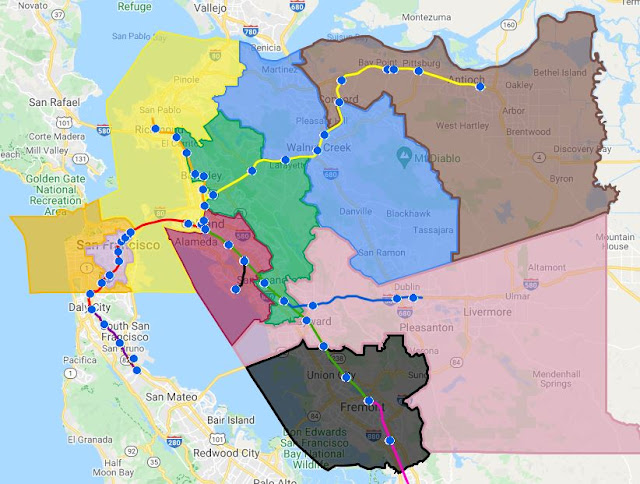
- We agreed to send a letter to the BART Board of Directors expressing the City's desire to remain in the current central county district, rather than be placed in the east county district.  If Clayton were to be moved to east county, it would contradict existing transportation planning in the county and not be representative of where the majority of Clayton residents use BART services.

- We discussed the 10 year general fund forecast and it is bleak at best.  Here is a look at the operational deficits that are projected beginning with the next fiscal year (Jul-22 - Jun-23):

The outlook is actually worse than the above indicates because it doesn't include deficit projections in some of our special revenue funds for things like streetlights and stormwater.  Those shortfalls align with the above and would need to be made up from the General Fund.  This would only be the baseline - there are other areas that the city has not been able to keep up with that require significant one time spending, and ongoing spending to support.  Things like police staffing, market rate wages for city staff to improve retention, rising costs of services for maintenance and audit services, etc.  If we aggregate all of these current unmet needs, it would put additional negative pressure of nearly $400K/year every year.

We have enjoyed a healthy reserve balance for quite some time.  But with operating expenditures increasing approximately 4% each year, and revenues only increasing 1.4%, it's an unsustainable pattern that needs to be addressed.

- Next we discussed how to address these financial challenges.  Back in July 2021, I raised this issue - either raise taxes, cut services, or both.  https://www.jeffwanforclaytoncitycouncil.net/2021/07/question-raise-taxes-reduce-services-or.html . I also started a poll on Nextdoor (https://nextdoor.com/news_feed/?post=193887740&is=neighbor_profile) with the same article, and there was quite a bit of discussion around that time.  Since then I've requested that we begin talking about the process for putting a ballot measure before the voters.  I'm glad we are now revisiting the issue, though it would have been more desirable to start earlier.

The Council went over different types of tax measures, amounts, whether it should be a general tax or a special tax (specific purpose), and whether we should engage outside consultants to help with polling, communications, and drafting ballot language.

There was general agreement that a parcel tax would be the best choice, rather than a sales, business, or utility tax.  A general tax can be used for any purpose, and has a lower threshold for voter approval (50% +1) so that was the direction the Council was moving towards.  

The amount of the potential tax was discussed, but a figure wasn't settled on.  I requested additional information about what could be achieved at different levels of funding.  This will allow a more informed discussion when we seek approval - we need to be able to clearly articulate what it is the people will get if they approve any tax.

We were split on whether outside consultants should be engaged.  I think the city has been to liberal with its spending on outside consultants.  I don't believe a polling firm will tell us anything that we don't already know, and the results of any poll are not likely to influence the outcome of what we do regardless.  We know we need to raise revenue - we should determine what the lowest amount possible is, and set the number there.  There is no poll that will change that outcome.  

I am also opposed to hiring a communications consultant.  Again, we know the channels and methods we can use to reach out to Clayton residents.  Compound that with the fact we just engaged consultants to help communication efforts around ARPA, and the housing element, and the downtown lot - it's not like there are going to be new novel approaches that were not previously considered.  

I think if we are asking the people of Clayton to agree to a tax increase, the City needs to demonstrate that it is using its resources as effectively and frugally as possible.  If we are loose with our spending, it would be more difficult to persuade the people to give the city more money.

In about a month, staff will come back with more information regarding the level of funding to seek, as well as information about potential costs of various outside consultants and what services they can provide.

Monday, January 31, 2022

Upcoming Council Meeting 2.1.22

There are a few significant items we will be discussing at our next council meeting:

  • Discussion whether to send a letter to the BART Board of Directors regarding upcoming redistricting.  There is a proposal that BART is considering to move Clayton to the eastern Contra Costa County district, rather than the current central district.  If Clayton is moved, then our representative would be from District 2, (brown section) vs. District 3 (blue section)

  • We will be discussing the ten year general fund forecast.  Current projections show deficit general fund spending starting next fiscal year.

  • We will also be discussing revenue options and potential next steps to address the projected deficits in the prior item.

If you have any thoughts or questions about the above, please let me know.

Wednesday, January 19, 2022

1.18.22 Meeting Summary

Last night the Council discussed several significant items:
  • We updated the city's purchasing policy to increase the threshold for when Council approval is necessary.  In the last two years we have updated the purchasing policy to allow us to utilize competitive bids conducted by other public agencies which reduced the administrative burden for similar services being sought, and adopted new rules related to public works projects further reducing administrative burden while retaining competitive bidding when appropriate.  With tonight's action, we increased the discretionary spending authority of the city manager from $20K to $60K, for everything except professional services.

  • The $20K limit has not been increased since 2004. The original intent of this threshold was to facilitate smooth operations of the city and not require Council approval for routine matters that would typically be approved via consent calendar anyways.  With rising costs over time, the $20K limit would sometimes be a barrier to that purpose.  Originally the proposal was to include all spend, however I questioned the need to include professional services which is typically consultant spend.  While the city does not often engage consultants, we have several times in the last few years.  In some cases, as with the group assisting us in preparing the housing element, or the group assisting in preparing the ARPA funds spending plan, this seemed entirely appropriate.  In others, I thought it warranted more discussion.  I suggested we limit the spending authority for professional services to $30K.  This would allow regular operations, while also ensuring larger engagements come to the Council for approval.

  • We approved one time premium pay for the City's essential workers in the amount of $10K each for full time employees.  Our police and city staff have worked diligently throughout the changing circumstances of the pandemic.  Our police especially has always been public facing.  As the ARPA dollars we received are federally funded, use it or lose it, and premium pay falls within eligible uses, I am grateful that we had this opportunity to recognize the work that our city staff does, and hope that this premium pay helps mitigate or offset some of the impacts that the pandemic has had on our police and city staff.

  • We expanded the eligibility criteria for the Clayton Cares program.  With updated guidance from the U.S. Treasury, we determined we could expand the scope of those eligible.  Originally businesses in Clayton could apply for forgivable loans up to $5K.  We increased that amount to $10K (those that already applied do not need to take action).  We also increased the amount households were eligible for, from $1,500, to $10,000.  The income threshold for households was also increased in hopes of capturing more homes in the eligibility pool.  We also extended the deadlines to apply for these amounts - through 1.31.22 for businesses, and 2.28.22 for households.  If you, your business, or a non profit think you may be eligible, please apply here:  https://claytonca.gov/claytoncares/

  • We also updated both the City Manager compensation package as a result of the annual review, and updated the city salary schedule accordingly.

Tuesday, January 18, 2022

Upcoming Council Meeting 1.18.22

There are a few significant items on the agenda for tonight's meeting:
  • Discussion of an updated purchasing policy adjusting some administrative items and increasing the approval authority of the City Manager from $20K to $60K.

  • Discussion of premium pay for essential workers in the city consistent with the discussion we had at our last meeting.

  • Considering whether to update the Clayton Cares program to expand eligibility for ARPA funds for local businesses and residents.

  • Updating the employment agreement with the City Manager reflecting a pay increase

  • Updating the City's salary schedule.

If you have any thoughts or questions on the above please let me know.

Wednesday, January 5, 2022

1.4.22 Meeting Summary

There were a few significant items that were discussed at last night's meeting.  Three items on the agenda, and one on consent calendar.

The consent calendar item had to do with the cost overruns of the curb ramp replacement project that is in progress right now.  Apparently when the city and our engineer originally scoped the work there were several items not included that should have been.  As a result, there was additional work needed to comply with various requirements, including ADA requirements, which necessitated an increase in the total project cost.

We discussed and established Council assignments on various committees.  There were a couple questions about the nature of those committees and if that information was available on the city website.  I had happened to have an older draft from when I came on the Council so I forwarded that to the City Manager to update and post if possible.

We discussed "hero pay" for essential workers that work for the city.  This included police and our city staff.  While I reiterated my top priority was to assist the local businesses and households in Clayton that were impacted by the pandemic, the low take rate on our initial program meant that we would have some funds available to also recognize the work that our own employees have been doing.

I suggested that we create various buckets of funds.  Doing this would allow us to get a bit more granular on any program we implement or modify.   Originally when the Police Officers Association suggested this action, they keyed their request in line with other nearby cities.  But given our size, we have a bit more flexibility in administering a program because the recipient pool is much smaller than in other nearby cities.  I suggested that of our total net allotment of funds (approximately $2.7M after administrative overhead), we designate 10% towards essential worker pay.  And while the broader topic of the other potential categories was not on the agenda so we couldn't take action on it, we did commit to bringing back this topic to further refine the program.  We agreed that a 10% target to go towards our essential workers was prudent and directed staff to work towards bringing back a program that met those guidelines.

We received one public comment about the apparent disparity in compensating our own employees while many in town were not eligible for the first round of the Clayton Cares program due to various circumstances.  In fact, less than 10% of the first tranche of funds was even claimed by local businesses and households.  It is clear we need to do two things - expand the Clayton Cares program to include more eligible recipients, and we need to more aggressively communicate the availability of this program to ensure those eligible can receive the funding that has been provided.  

The work here is definitely not done, but we can make incremental steps and implementing a program that recognizes our essential workers is a key component of that work.

We then discussed a progress report on the 6th Cycle Housing Element update.  The focus of this discussion were the draft goals, however there was a lot of information in the update which expanded the discussion quite a bit.  The draft goals were fairly high level, and the process would entail the Council making comments on the goals, then turning them over to the Planning Commission for them to get more into the details and ultimately make a recommendation on adoption.  The goals were drafted as follows:
    • Goal I. Maintain and enhance long-established housing and neighborhoods in Clayton while accommodating moderate growth.
    • Goal II. Encourage a variety of housing types, densities, and affordability levels to meet the diverse needs of the community, including a mix of ownership and rental units.
    • Goal III. Meet the housing needs of extremely low-, very low-, low-, and moderate-income households and increase opportunities for renters and first-time homebuyers.
    • Goal IV. Remove governmental constraints and obstacles to the production of housing for all income groups.
    • Goal V. Ensure equal housing opportunities for all persons in Clayton regardless of age, race, religion, sex, marital status, national origin, color, disability, or other barriers that prevent choice in housing.
    • Goal VI. Encourage and improve energy efficiency in new and existing housing.
    • Goal VII. Promote and participate in the resolution of housing, employment, and transportation issues on a regional basis in cooperation with all Contra Costa County jurisdictions.
I took issue with the first goal as "accommodating moderate growth" was nebulous in its meaning and it didn't appear to be a requirement to have.  I suggested that we instead modify the language to reflect the goal that we meet the various criteria as required by law.  Other than that, the rest of the goals appeared okay as many of them are required to be included.

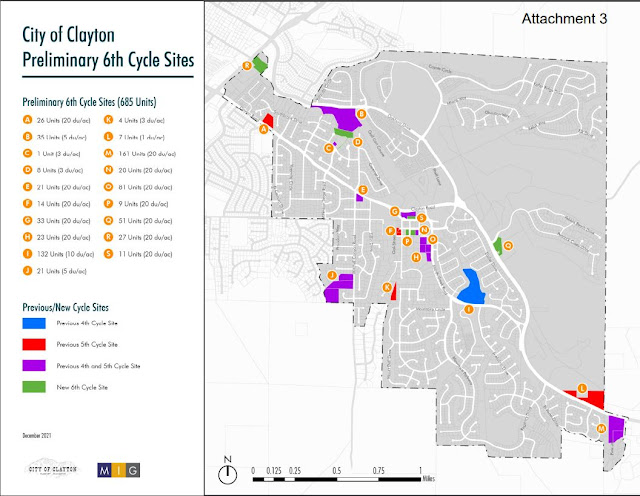
There was also significant discussion around the 3rd attachment (page 142 of 172 of the agenda packet):

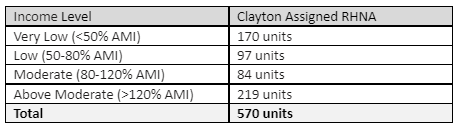
It was emphasized that this was merely a first draft of a proposal.  You may recall that we are required to provide for 570 units at varying income levels:

There are some requirements that if an opportunity site was included in the last two housing element cycles then it will be required to provide at least 20% of the units at that site as very low income.  One way to satisfy this is to change the zoning to be 20 units/acre.  I inquired if there were other ways to satisfy this requirement because if we move forward with the draft as presented, it would mean increasing density all over the city.

I did mention that we have some latitude because the city actually owns some of the opportunity sites that have been identified.  So while in other instances if a zoning density increase occurs, the property owner then has a by-right ability to build at that density, in the instance where the city itself owns the property, it will have ultimate decision making authority whether anything gets built on those sites at all.  The law requires that we zone at a certain density, not that any build actually occurs.

There will be more discussion over the course of 2022, however the options available to the city are limited as the state has constrained a great deal of choices that cities have.  We will definitely need to zone for the units, the question is where.

We also had a closed session regarding labor negotiations and there were no reportable actions from that closed session.